
Tesla's Flying Roadster: What's Real, What's Hype, and How the Rocket Tech Actually Works
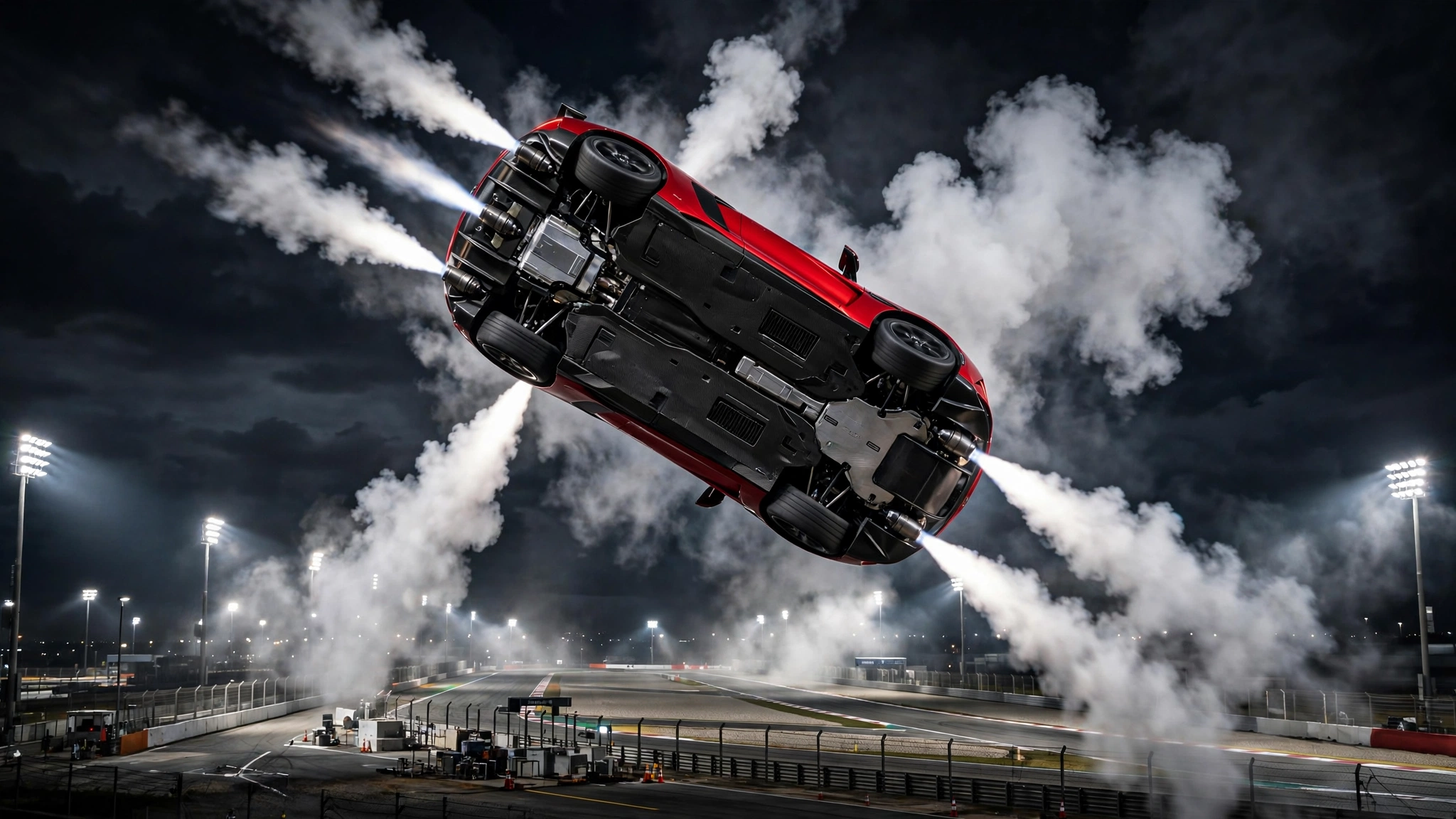
If your feed has shown you a car flying this month, you're not imagining it. On October 15, at SpaceX's test site in McGregor, Texas, Tesla finally unveiled the second-generation Roadster — nearly nine years after the concept was first shown — and it didn't just drive onto the stage. It climbed a wall, hung upside down, launched into the air, flipped, righted itself with bursts of white gas, and landed on its wheels. Elon Musk's summary: "Flying cars are real."
Well — sort of. What Tesla demonstrated is genuinely remarkable, genuinely rocket-powered, and also genuinely not what most of the viral posts claim it is. (Some of those posts aren't even real footage: a wave of AI-generated "Tesla flying car" clips spread after the event, several posted by AI video tools advertising themselves.) So let's do what we always do here — the same real-versus-hype test we applied to AI in healthcare — and separate the engineering from the showmanship.
What Actually Happened at the Demo
The unveiling, streamed live from SpaceX's rocket-testing facility, was built around a sequence of stunts rather than a normal car reveal:
- The wall climb. The Roadster drove up a huge curved ramp that bent past vertical into an overhang — and stayed stuck to it, upside down, thanks to a fan suction system under the car.
- The flip. It launched off the end of the ramp still inverted, fired its thrusters in mid-air to roll itself upright, hovered briefly, and landed on its wheels.
- The jump. In a second run, it lifted over a line of parked Tesla vehicles — including a Cybertruck and a Semi — flipping as it went.
Two details the highlight clips usually skip: the demonstration car was operated remotely, with nobody inside it, and Tesla itself says the stunt configuration is not street legal. Musk was also surprisingly blunt about priorities, telling the audience this is "not necessarily a safety-optimized car" — but one that takes "the fun meter to 11 out of 10."
Short on time? Watch our 50-second explainer:
The demo, the thruster technology, and the reality check — in under a minute.
How the Rocket Technology Actually Works
The system is the long-promised "SpaceX package," and the name is more than marketing. Two separate technologies are at work:
1. Cold-gas thrusters — rockets without fire
Around the car sit ten small thrusters. They are not jet engines and they burn nothing. Each one is a nozzle that releases gas stored at extremely high pressure — around 10,000 psi — from carbon-fibre overwrapped pressure vessels, the same kind of tank (called a COPV) that flies on rockets. Roughly 600 litres of tank volume is packed into the car.
The physics is Newton's third law in its purest form: throw gas out of a nozzle very fast in one direction, and the car gets pushed in the other. SpaceX has used exactly this principle for decades — Falcon rockets steer themselves in space with cold-gas thrusters. The difference is one of scale: on a rocket, the thrusters only nudge and steer while the main engines do the lifting. On the Roadster, the thrusters do everything — accelerating, braking, cornering, and yes, lifting.
And that difference has a hard limit built into it: the tank empties. Compressed gas delivers enormous force for a very short time. Engineering analyses of the demo figures suggest a full tank holds enough gas for roughly six to seven seconds of hover — which matches the demo, where the airborne moments lasted about four seconds. Tesla says the car can refill its own tanks, but it hasn't published how long a refill takes or how many full-power bursts a tank holds. Until it does, "flying" in this car means seconds, not minutes.
2. Fan suction — the upside-down trick
The wall climb uses a completely different system: powerful fans that pull air out from beneath the car, creating a vacuum seal against the surface. Tesla claims the suction is strong enough to hold the car upside down even standing still — engineers who ran the numbers estimate over 10,000 pounds of downforce on a car weighing about 4,400 pounds, so the maths is plausible. The idea isn't new, either: Formula 1's famous 1978 Brabham "fan car" used the same trick, won its only race, and was promptly withdrawn. On the road-going Roadster, the point isn't ceiling driving — it's grip. Suction means cornering force at any speed, including from a standstill.
The Three Versions — and What They Cost
Tesla is taking reservations for three trims, and only the first is a normal (if extreme) road car:
- Performance — the road version: fan suction and active aerodynamics, a claimed 0–60 mph in under 1.6 seconds. Reservations reopened in September at $50,000.
- Thrust — adds rear cold-gas thrusters for a claimed 0–60 under 0.9 seconds (Tesla posted a 0.81-second run from the event). Deposit: $250,000. Limited release.
- Rocket — the full system: thrusters all around the car for lift and mid-air control, a single seat, invite-only, and explicitly not approved for public roads. This is the one that "flies."
Production is guided for 2028 — and it's worth remembering the Roadster's history before treating that date as a promise: the car was unveiled as a concept in 2017 with deliveries promised for 2020, and has missed at least seven dates since. Original 2017 deposit holders are still waiting for their cars.
What's Real, and What's Hype
✅ Genuinely real
- A production-intent car left the ground under its own thrust, steered itself in mid-air, and landed — live, in front of an audience. That has never been done by a road car before.
- The technology is real rocket hardware: cold-gas thrusters and composite pressure tanks are mature, well-understood SpaceX technology.
- The fan-suction grip system works on a proven principle with a racing pedigree.
⚠️ Hype, for now
- "Flying car." This is thrust-assisted hopping — seconds of lift to clear obstacles or correct the car's attitude. It does not take off, travel somewhere, and land. No height or flight-time figures have been published.
- The performance numbers. 0.81 seconds, 230+ mph, 300+ miles of range — all are Tesla's own claims from a staged event, with no independent timing or testing yet.
- "On sale now." You can reserve; you cannot buy. Production is guided for 2028, from a program famous for slipping.
- The viral clips. Many of the most-shared "Tesla flying" videos online are AI-generated fakes made after the event. The real footage is spectacular enough — check the source before sharing.
So What Is the Future of Flying Cars, Really?
Here's the honest conclusion: the Roadster is not the future of transport, and it isn't trying to be. It's a halo car — a technology demonstration wearing a price tag — and judged that way it's a success, because the underlying trick matters more than the stunt.
The realistic near-term value of thrusters on a car isn't flying over traffic. It's safety and control in emergencies: a burst of thrust to brake harder than tyres alone allow, to stabilise a car mid-skid, or to hop a sudden obstacle. Those uses need one or two seconds of thrust — exactly what a tank of compressed air can actually deliver.
Actual flying taxis are developing on a completely separate track — electric vertical take-off (eVTOL) aircraft from companies like Joby and Archer, working through aviation certification the slow, proper way. That certification is the real wall for everything that flies: the Roadster's thruster system has no aviation approval, and a machine that can fall out of the sky onto a street faces a regulatory mountain no demo can jump over, however good the thrusters are.
Our prediction: by 2030, a handful of wealthy owners will own a Roadster that can hop, flip, and thrill — a toy, honestly marketed or not. Thruster-assist ideas may quietly filter into high-end performance and safety systems. And the car that picks your kids up from school will still have four wheels on the ground. The future does apparently have flying cars. It just turns out they're cars that can fly for six seconds — which, to be fair, is six seconds more than any car before them.
Frequently Asked Questions
Did Tesla really make a flying car?
Partly. At the October 15, 2026 unveiling, a Roadster prototype genuinely lifted off, flipped, hovered briefly and landed using rocket-style cold-gas thrusters. But it flies for seconds at a time in controlled demonstrations — it is not a vehicle that can fly you anywhere, and the demonstration car was remote-controlled with nobody inside.
How does the Roadster fly without wings or propellers?
With cold-gas thrusters: ten nozzles that blast out air stored at around 10,000 psi in carbon-fibre tanks. The escaping gas pushes the car in the opposite direction — the same principle rockets use to steer in space. Because the tanks hold a limited amount of gas, each flight lasts only a few seconds.
Can I buy one?
You can reserve one. The Performance trim takes a $50,000 reservation, the thruster-equipped Thrust trim a $250,000 deposit, and the flying Rocket trim is invite-only and not road legal. Production is guided for 2028, though this car's deadlines have slipped many times since 2017.
Are the Tesla flying car videos on social media real?
The event footage from Tesla's livestream is real. But many clips that spread afterwards are AI-generated or AI-edited — some were posted by AI video tools as adverts for their own products. If a clip shows the car soaring over a city, it's fake; the real car hops for seconds over a test track.
Will flying cars be normal by 2030?
Almost certainly not in this form. Thrust-based flight is limited to seconds by simple physics — the tank runs out. The vehicles most likely to carry passengers by 2030 are certified eVTOL air taxis, which are aircraft, not cars. Expect the Roadster's thruster tech to influence performance and safety features long before it changes anyone's commute.